The IT hiring in India 2026 trend is showing an interesting shift this year. Demand for jobs related to Artificial Intelligence (AI) and Machine Learning (ML) is increasing, but this does not mean that every job category in the IT sector is experiencing the same growth. Companies are increasingly looking beyond general technical knowledge and focusing on problem-solving, data interpretation, and the ability to use AI tools effectively.
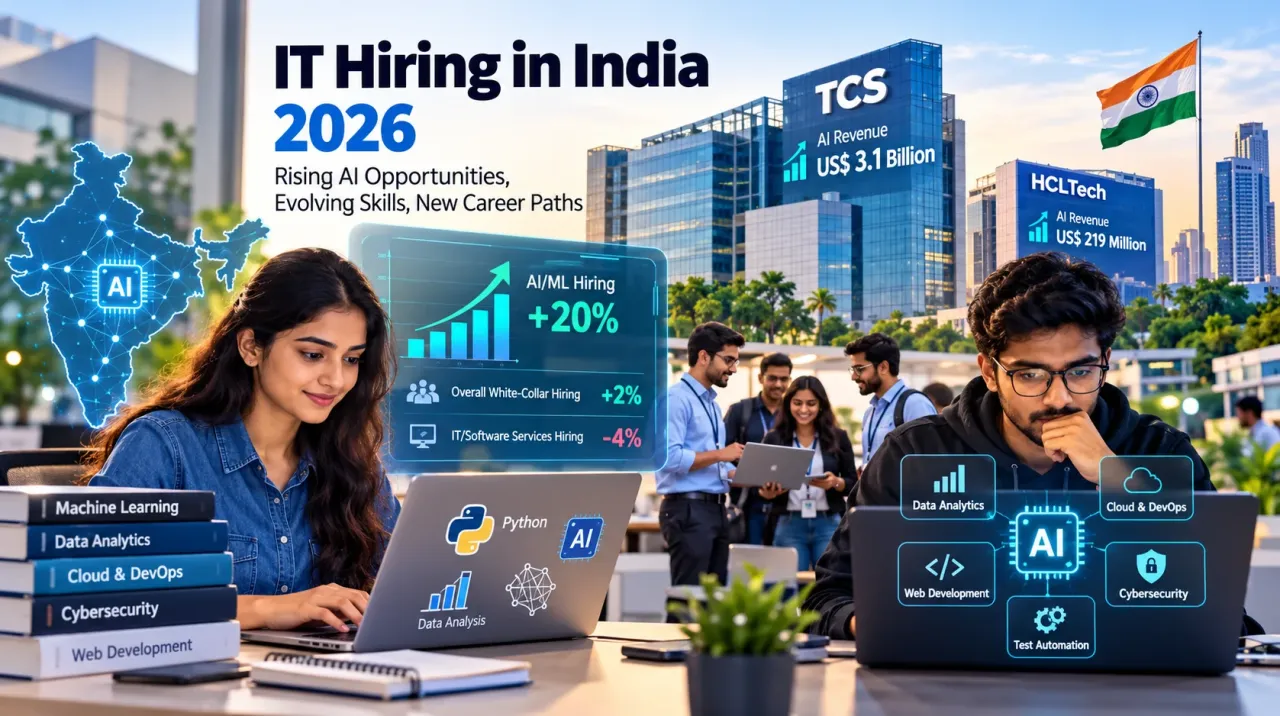
According to the Naukri JobSpeak report published on October 6, 2026, white-collar hiring in India increased by 2% year over year in September, while AI/ML-related roles recorded 20% growth. In contrast, overall hiring in IT/Software Services declined by 4%. This difference shows that opportunities remain available in the job market, but the importance of relevant skills and specialization is increasing.
Source: Naukri JobSpeak — October 2026 Report
What Is the IT Hiring Situation in India in 2026?
Understanding hiring in India's IT industry requires more than looking at the total number of jobs. It is also important to identify which areas are experiencing higher demand and where companies are taking a more cautious approach.
The key figures from Naukri JobSpeak's September 2026 report are as follows:
| Hiring Category | Year-over-Year Change |
|---|---|
| Overall white-collar hiring | +2% |
| AI/ML jobs across all tracked sectors | +20% |
| Overall hiring in IT/Software Services | -4% |
| AI/ML hiring within the IT sector | +11% |
| AI/ML hiring for freshers in IT | +19% |
| Fresher hiring across all sectors | +1% |
These figures show that job opportunities are not growing equally across every category in the IT sector. AI and machine learning roles recorded an increase, while overall hiring in IT/Software Services remained weaker. For job seekers, this means it is more useful to focus on the demand for their chosen role, the required technical qualifications, and available vacancies rather than looking for opportunities in the IT sector generally.
Keep in mind that these figures represent year-over-year comparisons for September 2026. They do not guarantee future hiring growth.
Why Is Demand for AI Jobs Increasing?
Businesses are finding practical uses for AI in everyday operations. It can assist support teams with customer queries, help organize information in documents, support software testing, and reduce the manual effort involved in routine reporting. The results depend on how each company implements and checks these tools.
The following roles are worth exploring as potential career options.
1. AI and Machine Learning Engineer
Professionals in AI and machine learning build, test, and improve systems that learn from data. Beginners interested in this field can start with Python, statistical fundamentals, data preparation, and methods for checking whether a model produces reliable results.
2. Data Analyst
Data analysts interpret information from different sources and turn it into reports and business insights. Excel, SQL, Power BI, and the ability to explain data clearly can be useful in this role.
3. Cloud and DevOps Engineer
Cloud and DevOps teams help applications run consistently as business needs evolve. Learning how to work with cloud infrastructure, Linux systems, version control, automated deployment pipelines, and performance monitoring can provide a foundation for this role.
4. Cybersecurity Specialist
A key responsibility in cybersecurity is reducing the risk of unauthorized access, data exposure, and attacks on digital systems. Someone entering this field can begin by studying how networks operate, learning to interpret system logs, understanding access controls, and practising essential security procedures.
5. Software Developer and Test Automation Engineer
Software development has not disappeared, but the way developers work is changing. Along with programming, code review, testing, debugging, and secure software development remain important. AI-generated code should not be accepted without checking its accuracy and reliability.
Important: These roles are presented as potential career options, not as proof that hiring is increasing in every category. To understand the actual demand for a particular position, review recent job listings and the official careers pages of relevant companies.
What Do TCS and HCLTech's AI Developments Indicate?
Recent business announcements from major Indian technology firms offer a glimpse into how AI is becoming part of their service offerings. Their reported investments and business figures help illustrate this shift, although they do not reveal the full impact on hiring by themselves.
TCS: Growth in AI Business
In its October 2026 business announcement, Tata Consultancy Services (TCS) reported an important figure related to its AI business: annualized AI revenue reached US$3.1 billion. Other initiatives mentioned by the company included collaboration with Porsche and efforts to develop AI-focused capabilities at Best Buy's Global Capability Center in India.
These examples indicate that major IT companies are giving AI a larger role in their business operations. However, these announcements should not be treated as direct evidence of an increase in the number of new jobs.
Source: TCS Official Financial Announcement — Q2 FY 2027
HCLTech: Increase in AI Revenue
According to a Reuters report published on October 13, 2026, HCLTech's annualized AI revenue increased from US$171 million in the previous quarter to US$219 million.
Source: Reuters — HCLTech Report
Together, these developments suggest that major IT companies are investing in AI-related services and capabilities. However, higher AI revenue does not automatically mean more jobs will be created. Hiring depends on several factors, including projects, customer demand, costs, and the skills companies need.
How Freshers Can Improve Their Chances of Getting an IT Job
For candidates looking for their first job, one of the biggest challenges is demonstrating technical ability despite having limited professional experience. Instead of collecting certificates alone, building projects that you can explain during an interview may be more useful.
A Practical 30-Day Plan
Week 1: Choose a Career Direction
Choose one area based on your interests, such as Python and data analysis, web development, cloud computing, or cybersecurity. Avoid trying to learn several technologies at once when you are just starting.
Week 2: Strengthen Your Fundamentals
Learn the core concepts in your chosen field and practise them through small exercises. For example, if you choose data analysis, write SQL queries and prepare a simple report using an openly available dataset.
Week 3: Build a Practical Project
Choose a project that solves a specific problem. Examples include a sales report for data analysis, a useful small application for web development, or a solution that automates a repetitive task.
Along with the project, document:
The problem you wanted to solve.
The tools and technologies you used.
The result you achieved.
The limitations of your solution.
Week 4: Prepare for Applications and Interviews
Keep your résumé clear and relevant, showcase your project on GitHub or in a portfolio, and apply for roles that match your skills. Practise programming questions, technical concepts, and questions related to your own projects.
This 30-day plan is intended to help you begin learning and applying for jobs. It does not guarantee employment.
Which Skills Should You Learn for an IT Job?
Technical requirements vary from one IT role to another. Use the guide below to identify the foundational skills associated with each career area, then compare them with the requirements listed in actual job postings.
| Career Path | Useful Entry-Level Skills |
|---|---|
| AI/ML | Python, data fundamentals, model evaluation |
| Data Analytics | Excel, SQL, Power BI |
| Web Development | HTML, CSS, JavaScript, Git |
| Cloud and DevOps | Linux, networking, Git, CI/CD fundamentals |
| Cybersecurity | Networking, log analysis, security fundamentals |
| Test Automation | Programming fundamentals, API testing, automated testing |
Using AI tools can be helpful, but checking their outputs, protecting data privacy, and understanding your own work are equally important. During interviews, describe only the skills you can explain and demonstrate with examples.
Will AI Reduce IT Jobs?
AI can speed up repetitive tasks and change the responsibilities associated with certain roles. This may affect demand for some traditional tasks, while creating opportunities in areas such as AI integration, data management, security, and system monitoring.
The available figures do not prove that AI will eliminate all IT jobs or that everyone who learns an AI skill will find employment. A more practical strategy is to strengthen technical fundamentals, learn to use AI tools responsibly, and build projects that solve real problems.
Conclusion
India's IT job market in 2026 presents a mixed picture. Naukri JobSpeak's September figures show stronger hiring activity in AI/ML alongside a decline in overall IT/Software Services recruitment. Meanwhile, AI-related business figures from TCS and HCLTech illustrate how technology providers are expanding their work in this area. These developments are useful indicators, but they should not be treated as a direct forecast of future job openings.
Job seekers can make their preparation more focused by selecting a role, identifying the skills employers request, and building a project that demonstrates those abilities. Before applying, compare your experience with the vacancy requirements and review openings on company career websites. A clearer understanding of job requirements can help candidates choose suitable roles and prepare for applications with greater confidence.
Explore DkTechnoLab for more technology insights, AI updates, and IT industry information. When learning about new technologies, verify information through official documentation and reliable sources.
Frequently asked questions

Written by the DkTechnoLab Team
Our Surat-based team of developers, designers and marketers has delivered 1250+ projects for 900+ clients since 2015. We write practical guides to help businesses make smarter technology decisions.
About us