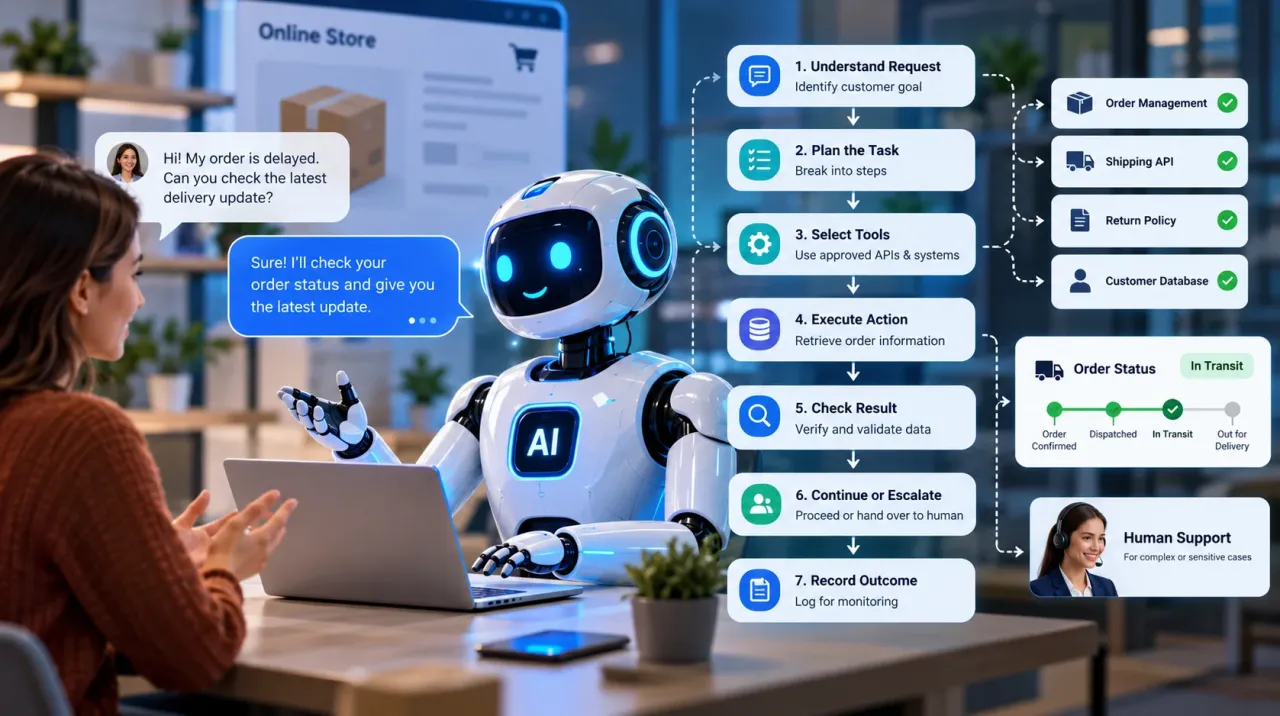
Every morning across growing commercial enterprises, skilled professionals spend valuable hours performing digital clerical labor. They export web orders into spreadsheets, retype customer records into accounting ledgers, paste tracking codes into courier portals, and message clients on WhatsApp. By midday, your team has closed no deals — acting merely as copy-paste bridges between isolated software systems.
This fragmented environment creates financial friction across operations. When applications cannot communicate directly, invoices stall, stock counts fall out of sync, and inquiries linger unattended. As sales expand, companies hire extra staff simply for manual data transfers, increasing payroll without improving output.
In 2026, modern businesses eliminate these bottlenecks through custom API integrations and workflow automation. When web portals, CRM databases, inventory systems, and payment channels share live data automatically, operational speed multiplies without adding payroll.
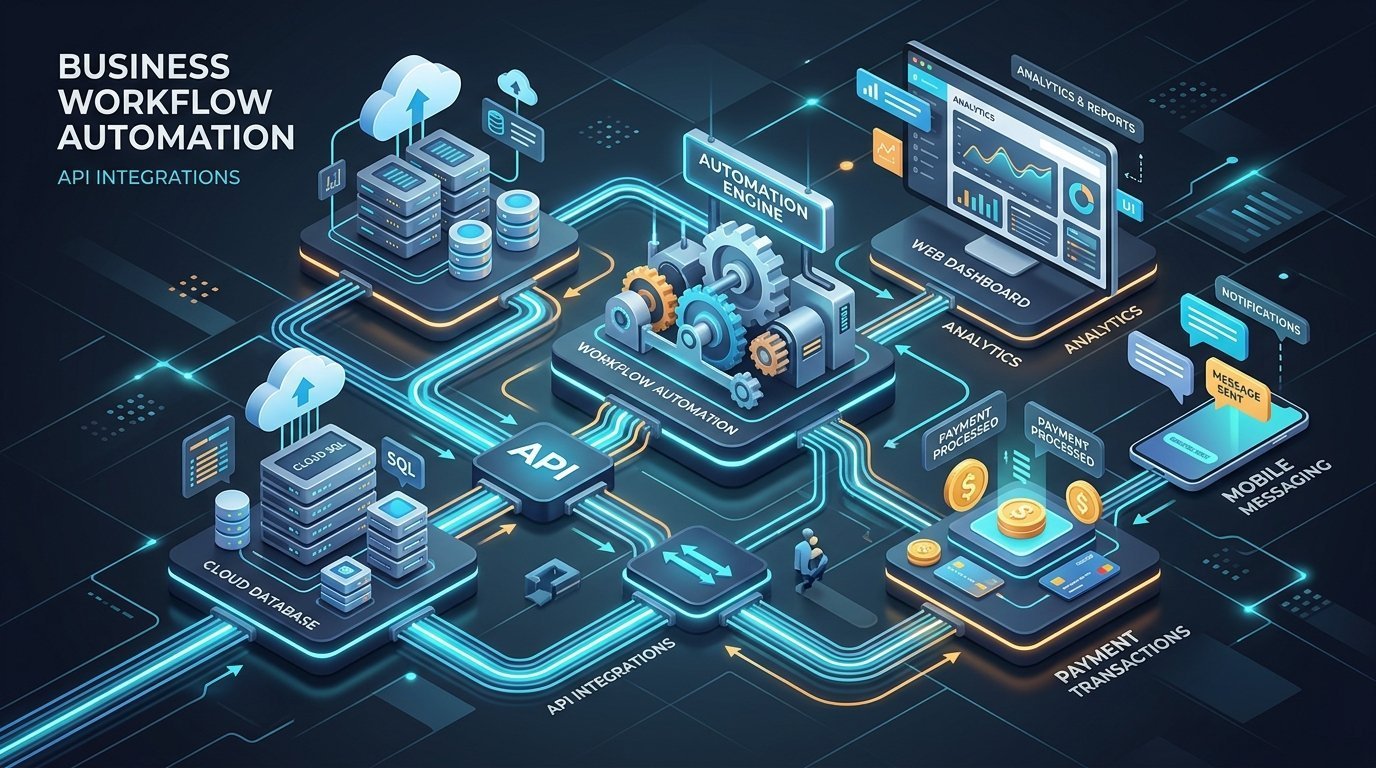
This practical guide breaks down what custom API workflow automation looks like in 2026, the real financial costs of disconnected systems, four high-value workflows every growing company should automate, and how to engineer resilient integrations that safeguard your business data.
What Is Business Workflow Automation via Custom APIs?
An API is a secure digital pipeline allowing software applications to exchange data and trigger tasks programmatically. Instead of downloading and re-uploading files, systems communicate directly in real time via structured protocols.
Business workflow automation orchestrates these connections around company rules. When a specific trigger occurs, the automation validates data and executes actions across other platforms instantly. For example, when a client completes an online payment, the automation issues an invoice in your accounting ledger, deducts purchased stock, notifies dispatch, and sends an automated WhatsApp receipt link.
The key distinction in 2026 lies between basic no-code connectors and custom-engineered API integrations. While off-the-shelf connectors suffice for simple web forms, growing businesses with proprietary workflows, multi-step transaction rollbacks, and high volumes need custom API middleware built to their exact technical specifications.
The Hidden Operational Costs of Disconnected Software
Business leaders track visible overhead such as rent and hosting servers. However, isolated software tools impose an unseen tax on day-to-day profitability:
- Data Entry Errors: Typing mistakes in phone numbers, GST credentials, or delivery addresses cause misrouted shipments, billing disputes, and irritated customers.
- Delayed Order Processing: When shipping requests sit in spreadsheet queues until late afternoon, dispatch deadlines pass, handing an advantage to faster competitors.
- Stock Discrepancies: When retail counters and digital storefronts do not share synchronized inventory, customers purchase items that are already out of stock.
- Bloated Operational Headcount: Adding clerical staff solely to transfer data between incompatible dashboards increases recurring overhead as the business scales.
- Fragmented Management Reporting: When leadership needs real-time clarity on revenue and margins, finance teams spend days assembling conflicting spreadsheets.
Automating operational workflows transforms these isolated applications into an integrated ecosystem where data travels accurately and without delay.
Four High-Impact Workflows Every Company Should Automate
Automating an entire enterprise all at once can feel overwhelming. These four workflows offer the quickest path to measurable productivity gains:
1. Web Portals to Accounting & ERP Synchronization
Every customer order on your custom web application or e-commerce store is financial data. Custom API connectors automatically convert online orders into sales vouchers, customer ledgers, and tax line items within platforms like Tally Prime or Zoho Books. Month-end reconciliation becomes instant instead of an exhausting chore.
2. Payment Gateway Verification and Automated Billing
Relying on staff to inspect bank balance screenshots slows business. Connecting payment gateway webhooks (Razorpay, Cashfree, Stripe) verifies payments in milliseconds, confirms orders, prevents duplicates, and issues GST invoices automatically.
3. WhatsApp Business Cloud API Customer Messaging
WhatsApp has become the primary communication medium for customers in India. Through direct integration with the official WhatsApp Cloud API, customer care teams no longer send manual updates. The system automatically sends dispatch updates, downloadable PDF invoices, and feedback surveys that sync directly into your CRM.
4. Warehouse Fulfillment and Courier Dispatch Automation
Manually generating shipping labels and booking couriers wastes hours. Custom API integrations connect packing desks with courier aggregators like Shiprocket or Delhivery. Once a warehouse team marks an order packed, the integration generates the air waybill, books carrier pickup, prints thermal labels, and updates tracking details automatically.
Comparing Automation Approaches: Manual vs No-Code vs Custom APIs
Before investing in automation, evaluate which strategy fits your operational scale:
| Factor | Manual Processes | No-Code Tools | Custom API Integration |
|---|---|---|---|
| Setup Speed | Immediate | Quick (few days) | 1 to 3 weeks |
| Ongoing Cost | High payroll costs | Task subscriptions | Predictable build |
| Data Security | Vulnerable sheets | Third-party cloud | Highest (private servers) |
| Business Logic | Human error | Limited flexibility | Complete custom logic |
| Failure Handling | Dependent on staff | Fails silently | Automated retry queues |
| Scaling Volume | Breaks under load | Costly tier jumps | Handles heavy volume |
No-code platforms suit simple experiments, but companies handling customer data, complex business rules, and high transaction volumes gain superior security and financial returns from custom API engineering.
Engineering Best Practices for Reliable Integrations
When software handles core financial transactions and logistics without manual oversight, technical stability is paramount. Professional integrations require these development safeguards:
- Idempotency Controls: Implementing unique transactional keys prevents duplicate billings or shipments when network drops trigger duplicate webhook payloads.
- Asynchronous Queues: Using background queues like Redis ensures temporary outages on external services never freeze your website or checkout flow.
- Strict Encryption: Utilizing OAuth 2.0 authorization, encrypted tokens, and TLS 1.3 keeps customer information safe from unauthorized access.
- Automated Error Monitoring: Telemetry systems alert developers immediately if external API credentials expire or data structures change, preventing customer disruptions.
Conclusion: Build a Smarter, Scalable Business
Software should free teams for growth, not clerical routines. In 2026, automated companies process orders in seconds, respond to customer inquiries rapidly, and scale revenues while keeping overhead lean.
Manual data entry is an expensive, avoidable inefficiency. Custom API integrations connect your separate tools into a reliable operational powerhouse that works with complete precision.
Whether connecting web portals with Tally, automating courier dispatch, or integrating WhatsApp customer alerts, partnering with experienced developers ensures systems operate smoothly and scale reliably.
Frequently Asked Questions (FAQs)
1. What is the difference between an API and a webhook?
An API allows your application to request data on demand, while a webhook is an automated alert pushed to your server the moment a specific event happens, such as an approved online payment.
2. Can desktop software like Tally Prime connect to web applications?
Yes. Through XML over HTTP bridges and secure sync middleware, modern web applications push sales vouchers, customer accounts, and receipt entries directly into Tally Prime without manual retyping.
3. How long does implementing custom workflow automation take?
Direct two-system integrations (like web-to-WhatsApp or payment webhooks) usually take one to two weeks, while complex ERP and multi-channel automations take three to four weeks from architecture to production deployment.
4. Are custom API integrations safe for proprietary company records?
Yes. Custom integrations operate on encrypted servers with token verification, providing far tighter security and access governance than sharing raw spreadsheets across employee computers.
5. How does DkTechnoLab assist with workflow automation and API integrations?
DkTechnoLab engineers custom web portals, backend APIs, and workflow automations for businesses in Surat and across India. We connect websites with WhatsApp Cloud API, payment gateways, courier aggregators, Tally, and custom ERPs to eliminate manual work and accelerate growth.

Written by the DkTechnoLab Team
Our Surat-based team of developers, designers and marketers has delivered 1250+ projects for 900+ clients since 2015. We write practical guides to help businesses make smarter technology decisions.
About us