Imagine an online store receiving hundreds of customer messages every day. Customers ask about delivery dates, returns, refunds and order changes. A traditional chatbot can answer common questions, but more complicated requests may require an employee to check an order system, review a policy and take action.
This is where agentic AI development can make a practical difference. Instead of only generating responses, an AI agent can interpret a goal, choose from approved tools, perform several steps and check whether the task has been completed.
However, giving AI access to business systems introduces new responsibilities. An agent must follow permissions, protect customer data and recognise when a human should take over.
This guide explains how agentic AI works, when businesses should use it, how to develop a reliable solution and what to consider before investing in one.
For more insights on technology, software development, and emerging digital trends, explore our latest technology blogs.
What Is Agentic AI Development?
Agentic AI development is the process of designing, building, testing and deploying AI-powered systems that can pursue defined goals through multiple steps. Depending on their configuration, these systems can plan tasks, call APIs, retrieve information, evaluate results and adjust their next action.
A conventional chatbot typically responds to a question. A traditional automation workflow follows predefined rules. An AI agent may decide which approved action to take next based on the task, available information and results of previous actions.
For example, a customer asking about a delayed parcel might need more than a written answer. An agent could retrieve the order status, check the estimated delivery date, compare it with the shipping policy and prepare an appropriate response.
The important distinction is that an AI agent should have bounded authority, not unlimited autonomy. It needs clear objectives, restricted permissions and rules for escalating uncertain or sensitive situations.
How Does Agentic AI Work?
An agentic system usually combines a language model with tools, business rules, application integrations and monitoring.
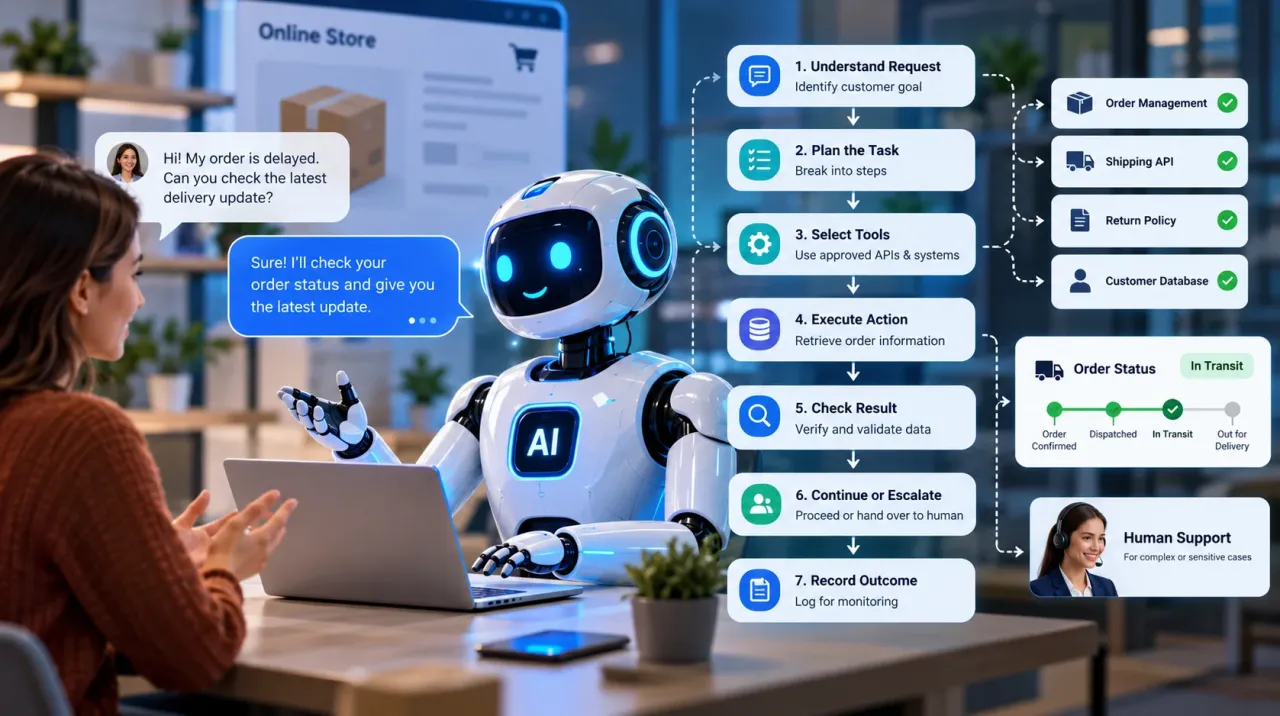
A typical workflow follows these steps:
Understand the request: Interpret the user's goal and identify missing information.
Plan the task: Break the request into manageable steps.
Select an approved tool: Choose an available API, database query or business application.
Execute an action: Call the tool using validated inputs and appropriate permissions.
Check the result: Confirm whether the tool succeeded and whether the output meets the task requirements.
Continue or escalate: Proceed when safe, retry within defined limits or request human assistance.
Record the outcome: Log relevant events for troubleshooting, evaluation and accountability.
Not every task requires all seven steps. A simple question may need only information retrieval, while a complex workflow may involve several systems.
Google Cloud's overview of agentic workflows provides further background on the relationship between planning, tool use and multi-step execution.
A Practical Example: An AI Agent for Customer Support
For an online retailer, checking delivery updates and explaining return procedures can take up a large share of the support team's time. An AI agent can assist with these requests by checking authorised order records and presenting customers with the relevant next steps.
The example below describes a possible implementation scenario for illustration; it does not represent results from a real client project.
A shopper contacts support because their parcel is overdue and wants to know its latest delivery update and the available options.
The agent could:
Identify the order number and verify the customer's identity through the approved authentication process.
Retrieve the shipment status from the order-management API.
Check the expected delivery date and the applicable shipping policy.
Explain the current status using information returned by the system.
Offer an eligible next step, such as creating a support ticket.
Request human approval if the case involves a refund, disputed payment or an exception to company policy.
Suppose the shipment API returns an error. A reliable agent should not invent a delivery date or claim that the order has been checked successfully. It should make only a limited retry if permitted, report that the status could not be verified and offer escalation.
This example illustrates a core engineering principle: the model can interpret and coordinate a task, but authoritative business systems should determine facts such as order status, refund eligibility and account permissions.
Agentic AI vs. Traditional Automation
| Factor | Traditional automation | Agentic AI |
|---|---|---|
| Workflow | Predefined steps and rules | Can select steps dynamically within constraints |
| Best suited for | Predictable, repetitive tasks | Tasks requiring interpretation and multiple actions |
| Flexibility | Usually follows configured paths | Can adapt to different inputs and tool results |
| Testing | Rule and scenario validation | Scenario testing plus model-output and tool-use evaluation |
| Main risk | Incorrect rules or integration failures | Those risks plus unpredictable model decisions |
| Human oversight | Depends on workflow design | Particularly important for uncertain or high-impact actions |
Agentic AI is not automatically better. If a task follows a stable sequence, conventional automation may be cheaper, faster and easier to maintain.
For example, generating a monthly invoice from verified database fields usually does not require an autonomous agent. Investigating a complex support request across multiple systems may benefit from one.
The best architecture is the simplest system that meets the business requirement reliably.
Core Components of an Agentic AI System
A dependable agent requires more than a capable language model.
1. AI model and instructions
The model interprets requests, proposes actions and generates responses. Instructions should define its role, limitations, allowed actions and escalation conditions.
2. Tools and integrations
Tools connect the agent to approved business systems, such as CRM software, order databases, knowledge bases or ticketing platforms. Each tool should have a clear purpose and validated input format.
3. Workflow controller
The controller manages execution, checks tool responses, enforces step limits and determines when the task should stop. Important business rules should not depend solely on the model following a prompt.
4. Context and memory
The system may need information from the current conversation or relevant records. Store only the information required for the task, apply appropriate retention rules and avoid exposing one customer's data to another.
5. Security and permissions
Use least-privilege access, authentication, input validation and server-side authorisation. Treat content retrieved from emails, webpages and uploaded documents as untrusted data because it may contain malicious instructions.
6. Monitoring and evaluation
Record tool calls, failures, escalations and task outcomes. Protect logs from unnecessary exposure of personal information, and establish a process for reviewing incidents and improving the system.
A Step-by-Step Agentic AI Development Process
Step 1: Define a measurable business problem
Start with one workflow rather than trying to automate an entire department. Document the current process, common exceptions, task volume, average completion time and error rate.
Choose a problem where improvement can be measured and where mistakes can be contained.
Step 2: Decide whether an agent is necessary
Compare a conventional rules-based workflow, a standard AI assistant and an agentic solution.
Use an agent when the task requires flexible interpretation or multi-step coordination. Avoid introducing autonomy when a simpler system can achieve the same result.
Step 3: Design the workflow and boundaries
Define the available tools, permitted actions, required approvals, retry limits and conditions for escalation. Decide which actions are reversible and which could create financial, legal or customer consequences.
Step 4: Build a small prototype
Connect the model to a limited set of tools and use synthetic or appropriately protected test data. Start in a sandbox rather than granting immediate access to production systems.
Test ordinary requests, incomplete inputs, conflicting instructions, API errors and unauthorised requests.
Step 5: Evaluate before deployment
Create a test set representing real task variations. Measure whether the agent selects the right tools, uses verified information, follows permissions and escalates correctly.
Review failure cases instead of relying on a few impressive demonstrations.
Step 6: Deploy with safeguards
Introduce the agent gradually. Monitor its performance, limit its access and retain a clear path for human intervention. Roll back changes if error rates or unexpected actions exceed defined thresholds.
Step 7: Improve using evidence
Review actual task outcomes, user feedback, costs and recurring failures. Update prompts, tools or workflow rules based on documented findings, then repeat the evaluation before releasing changes.
How to Evaluate an AI Agent’s Real-World Performance
A successful demonstration does not prove that an agent is useful in production. Businesses should measure outcomes against a defined baseline.
| Metric | What it tells you |
|---|---|
| Task completion rate | How often the agent finishes eligible tasks correctly |
| Escalation rate | How often a human must intervene |
| Error rate | How often the system makes an incorrect or unauthorised decision |
| Average handling time | How long a task takes from start to finish |
| Cost per completed task | The combined cost of model use, infrastructure and human review |
| Customer satisfaction | Whether the resulting experience meets customer expectations |
For example, if an evaluation contains 200 eligible test cases and 170 meet the predefined success criteria, the measured completion rate is 85%.
That result is meaningful only if success is defined in advance, the test cases are representative and failures are reported honestly. It should not be presented as a production result unless it came from a real production evaluation.
Businesses should also measure the quality of escalations. A system that refuses unsafe requests and routes complicated cases to the right employee may be performing better than one that completes more tasks but makes costly mistakes.
What Determines the Cost of Building an AI Agent in India?
There is no single reliable price for agentic AI development. Cost depends on workflow complexity, model selection, data readiness, integrations, security requirements and ongoing maintenance.
A limited proof of concept may require substantially less effort than a production system connected to customer records, payment systems and multiple enterprise applications.
Before requesting a quote, clarify:
The workflow and expected task volume.
Required integrations and existing API availability.
Data preparation, access controls and privacy requirements.
Evaluation, monitoring and human-review needs.
Hosting, model usage, maintenance and support costs.
Ask providers to separate initial development from recurring operating expenses. A low initial quote may not include evaluation, security testing or long-term monitoring.
The useful comparison is not simply the cheapest development proposal. It is the total cost of operating a solution that meets agreed performance and safety requirements.
Risks to Address Before Launching an AI Agent
Agentic systems can make decisions and take actions through connected tools. That makes governance part of the engineering process, not an optional final check.
Incorrect outputs: Require validation against authoritative sources before acting on important information.
Prompt injection: Treat retrieved documents and external content as untrusted. Do not allow them to override system-level permissions or tool restrictions.
Excessive permissions: Give each tool only the access required for its task. Separate read-only access from write or transaction permissions.
Unintended actions: Require explicit human approval for sensitive, high-impact or difficult-to-reverse operations.
Privacy exposure: Minimise personal data, restrict access and apply suitable retention and security controls.
Runaway execution and costs: Set limits on steps, retries, time, token use and expenditure.
Insufficient accountability: Keep appropriate audit logs, define an owner for incidents and establish a process to disable the agent when necessary.
The NIST AI Risk Management Framework offers a useful foundation for identifying, evaluating and managing AI risks across development and deployment.
How to Choose an Agentic AI Development Company
When assessing an AI development provider, look for a team that can demonstrate the system’s capabilities, define its access limits and explain how it will respond when a task falls outside its authorised scope.
When evaluating an AI development company, ask:
Can the team demonstrate a workflow similar to your use case?
How will the agent authenticate users and enforce tool permissions?
How will the system handle API failures, incorrect outputs and uncertain requests?
What evaluation criteria will be used before launch?
How will costs, performance and incidents be monitored?
Who will maintain integrations and review changes after deployment?
Ask for a defined proof-of-concept scope, acceptance criteria and a transparent cost breakdown. If a provider promises complete autonomy without explaining testing, permissions or human oversight, treat that as a warning sign.
For businesses exploring custom AI solutions, the goal should be a maintainable system that solves a specific problem—not autonomy for its own sake.
Conclusion: Build AI Agents Around Real Business Needs
Agentic AI development can help businesses coordinate complex tasks, connect existing applications and reduce repetitive work. Its value depends on choosing the right use case, designing dependable integrations and measuring performance against meaningful criteria.
Start with a narrow workflow, test it against realistic failure cases and introduce autonomy gradually. Keep business-critical permissions under control, require human approval where appropriate and monitor the system after deployment.
Looking to develop a practical AI solution? Contact us for AI development services. Discuss your workflow, existing software, security requirements and business goals to identify whether an AI agent is the right fit.
Frequently asked questions

Written by the DkTechnoLab Team
Our Surat-based team of developers, designers and marketers has delivered 1250+ projects for 900+ clients since 2015. We write practical guides to help businesses make smarter technology decisions.
About us